
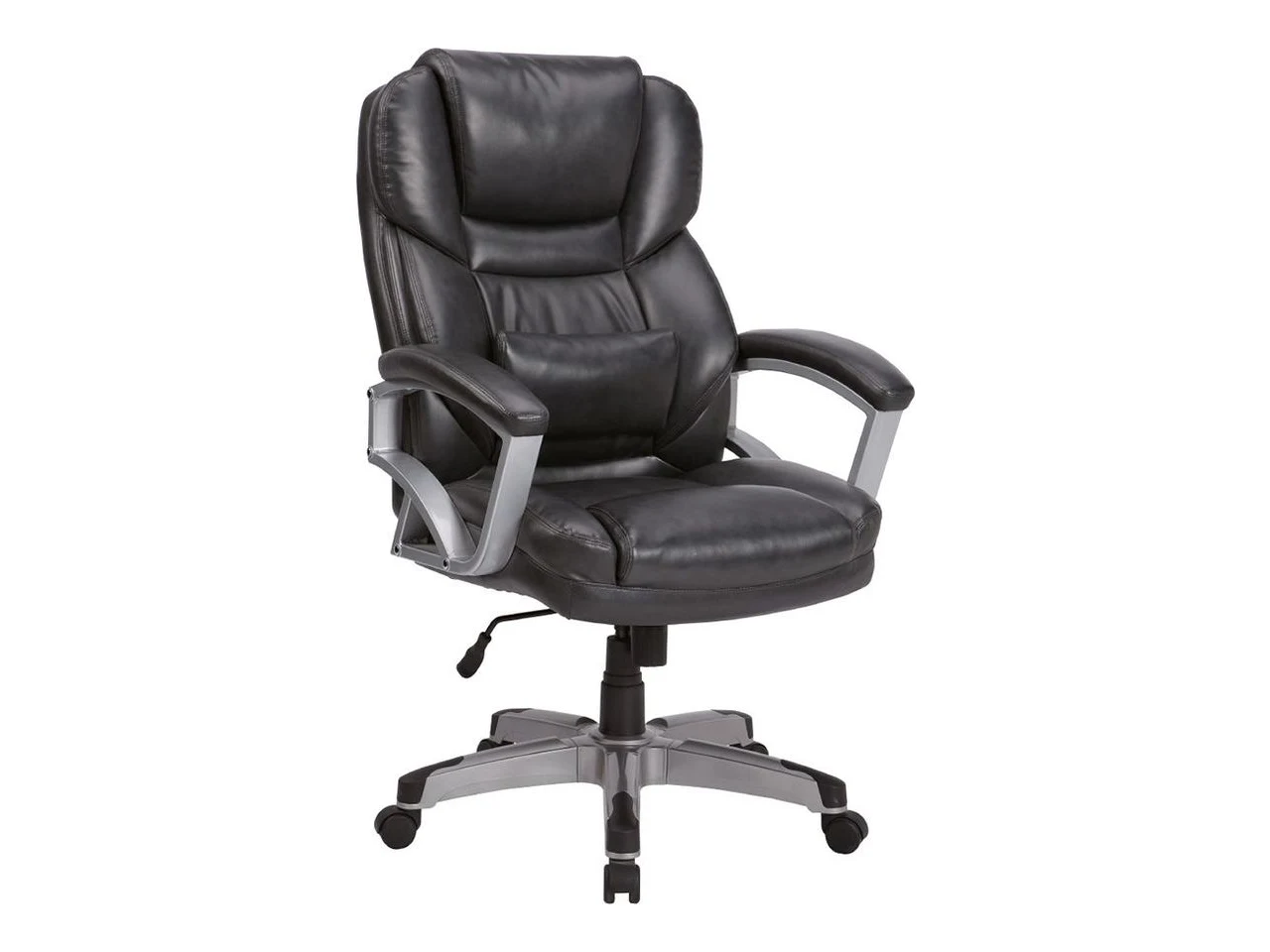
About once a week a buyer asks us to settle the argument: office chair or ergonomic office chair? We are in an awkward but useful spot to answer, because we build both on the same factory floor in Anji. We do not make more margin steering you to one or the other, so here is the version without the sales gloss.
They are solving two different sitting problems
An executive office chair is built around a contoured seat and a high back with wing bolsters. It hugs you, it looks fast, and the fixed lumbar and neck pillows feel great for the first few hours. An ergonomic office chair starts from a different premise: a flatter seat pan, a back that adjusts to your spine rather than a back you adjust yourself into. Go read the long threads on r/OfficeChairs and r/pcmasterrace and you will see the same pattern — most experienced sitters say the office look sells the chair, but the adjustment range is what they live with at hour seven.
That is not a knock on office chairs. It is a statement about fit. The bolsters that wrap a 175 cm home worker can dig into the thighs of a 190 cm player. The fixed lumbar pillow that lands perfectly for one person sits two inches too high for the next. An adjustable lumbar on an office chair sidesteps that by moving to the user instead of asking the user to move to it.
The honest trade-off
Here is the line we give brands. If your buyer is a teenager or a home worker who wants a statement piece and sits in three- to four-hour bursts, the contoured bucket wins on appeal and feels supportive enough. If your buyer is doing genuine eight-to-ten-hour desk days — back-office contract staff, content editors, a coworking floor — push them toward an ergonomic platform with real lumbar adjustment, or at least an office chair with an adjustable lumbar mechanism rather than a strap-on pillow. The bucket aesthetic costs you nothing in those models; the missing adjustability does.
There is a middle road we sell a lot of: a executive chair tuned for office duty — the bolstered silhouette buyers want, but with a quieter tilt, a flatter forward seat edge and a class-4 cylinder so it survives shared use. It is the chair that keeps the office worker happy and the procurement team out of warranty calls.
Where the two designs actually overlap
It is worth saying the gap has narrowed. A good office chair today borrows heavily from the office side: adjustable lumbar instead of a fixed pillow, 4D armrests, a class-4 cylinder, cold-cure moulded foam at 50–60 kg/m³. At that point the only real difference is the contoured seat shape and the bolsters, which are an aesthetic and a fit choice rather than an ergonomic verdict. The chairs that get a bad reputation in those Reddit threads are the cheap ones — thin bonded-PU over a plywood shell, a Class 3 cylinder, a strap-on pillow — not the category as a whole.
So the honest framing is not "office bad, office good." It is "cheap office chair bad." A well-built executive chair and a well-built mesh office chair are both fine for long sitting; they just feel different and suit different bodies. The mesh back breathes and disappears under you; the bucket holds you in one posture, which some players love and some find restrictive after a few hours.
A note on body size and seat width
One spec that gets ignored: seat width between the bolsters. A contoured bucket runs roughly 480–520 mm across the seat, and the bolsters that make it look fast also narrow the usable area. For a market with larger average users, a narrow bucket is a comfort problem and, eventually, a return. We can widen the seat pan or soften the bolsters on a office chair platform, but you have to tell us the user profile up front — it is a moulding decision, not something we change at the packing stage. The flatter seat of an ergonomic office chair sidesteps the issue entirely, which is another reason we steer larger-user fleets that way.
What this means for your order
When you brief us, tell us the average session length and the body range of the end user, not just the look you want. That single sentence changes which seat foam we mould, whether we spec a fixed or adjustable lumbar, and which armrest we fit. We would rather build the chair to the use than ship a good-looking seat that comes back.
If you are still deciding, browse our office chair range and our ergonomic office chairs side by side, then send the spec to our export desk and we will tell you which platform fits your market. We answer with real numbers, not adjectives.